

On this page3 sections
A routing model cannot choose a support team that was never offered as an option. That constraint is central to CLM-8B: supply a situation and candidate actions, and it scores how well each candidate fits. For a stable queue directory, this can be a focused alternative to generating an answer and parsing out a team name. The candidate list becomes part of what the system knows how to decide.
The Contrastive Language Models research release arrived September 23, 2026. Its downloadable CLM-v0.1-8B model pairs a frozen Qwen3-8B encoder with small trained projection heads under Apache 2.0. Rather than asking this model to compose a response, an application supplies the choices it wants ranked.
Reuse the choices, encode the new situation
CLM converts the situation and candidate actions into embeddings, numerical representations whose compatibility it scores. Candidates are encoded separately, allowing their embeddings to be reused for recurring choices. A ticket router can therefore reuse representations of the same team descriptions while encoding each new ticket. That saves repeated candidate representation work, but it cannot expand the answer beyond the supplied set.
Descriptions have to distinguish actual responsibilities for that ranking to be useful. A directory with clear team boundaries gives the model something meaningful to compare with a report. It also needs a way to handle incomplete reports, because the ticket’s ambiguity does not disappear when every candidate has an embedding.
The highest-ranked option can still be the wrong destination
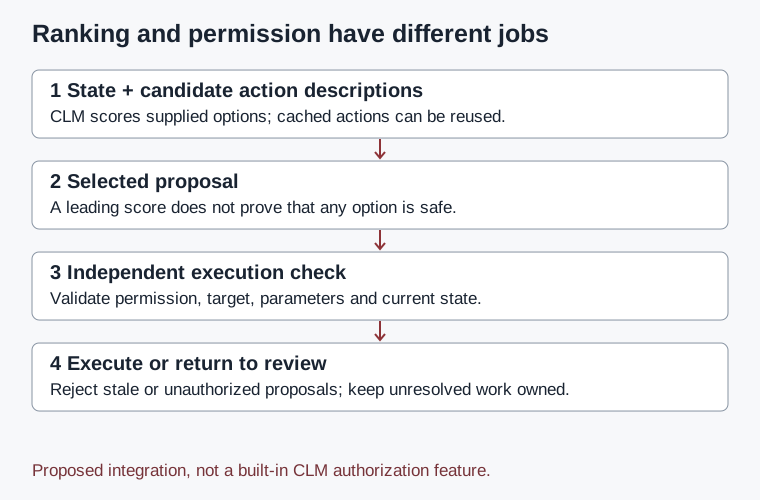
The model card defines probabilities relative to the candidates provided. A high score may therefore mean “best among these options” even if every option is unsuitable. The interpretation depends on the set as well as the number.
Consider a hypothetical ticket about an expired access credential offered only “database,” “network” and “application.” A forced selection could create another transfer because none names the appropriate destination. Including an explicit “unresolved” option in the candidate list gives the system somewhere to place that uncertainty, and a trial can examine whether it uses that option for the right cases.
If unresolved tickets have no reachable human triage owner, keep the model in recommendation mode. Compare misroutes and unresolved cases with the existing router alongside speed. A rapid classification helps only if the overall workflow gets work to someone who can handle it sooner.
Ranking an action does not establish permission to execute it
A successful queue trial would show routing value, not readiness to select and perform repairs. For tool calls, the executor must recheck the chosen target and its current state before acting. The production-agent guide makes approval specific to that action and state, preventing a useful score from silently becoming continuing authority.
Suppose a prepared restart candidate describes a worker replaced since the candidate was created. Its cached embedding still represents that option; it cannot establish that the replacement is the intended resource. Current service state and action parameters must be compared before execution can proceed.
The release’s agent benchmarks provide context, but its model card separates task-fine-tuned heads from the base checkpoint, so use the checkpoint the team actually intends to run. For the ticket router, replay the same labeled reports against a fixed candidate set, including the time to encode each report as well as the ranking, and follow disagreements to the team that should receive each ticket. That comparison shows whether reusable candidate scoring shortens the route to a usable destination, rather than merely producing a fast ranking.
Sources & context
Sources linked in this article. Read alongside the author’s analysis; a citation does not independently verify a publisher’s claims.
- introduced Contrastive Language Models on September 23, 2026contrastive-lm.notion.site
- model cardhuggingface.co
- project implementationgithub.com