

On this page5 sections
A platform engineer can leave an assistant a list of release-note pages tonight and review the relevant changes tomorrow. The sources and desired output are known, and the work can continue while the engineer does something else. That is one practical use for an agent whose task survives the end of a conversation. A connected-account update adds another complication: the plan itself can change while the assistant is still working.
Meta Muse brings that ongoing relationship into a personal-agent product. For an SRE or platform team, its usefulness can be explored in stages. A digest of public release notes tests whether it gathers and explains information worth reviewing. A later calendar-write trial asks a harder question: can a person still identify the permitted action and verify the result after the underlying plan changes?
How Muse continues a task after the app closes
Meta introduced the Muse personal agent on September 8, 2026. Powered by Muse Spark, the announced US rollout covers iOS, Android and the web. Meta says it can browse, use connected services and keep tasks running after the app closes. The launch describes free use with subscriptions for additional capacity; this guide does not assume a current price or account entitlement.
The product-design account describes a filesystem and terminal, document and interactive-artifact creation, persistent memory, and scheduled or event-triggered work. Goals, an activity log and structured approvals supply the user-facing controls. These are Meta’s product descriptions, not capabilities independently exercised for this article. They make Muse a managed agent service, distinct from a model checkpoint or an API workflow a team builds itself.
Voice and avatars add another layer to that experience. In the September 23 research post, Meta explains speech tokens driving synchronized video for real-time conversation. An approachable interface may make delegation easier, but cannot establish whether the resulting event, message or operational action is correct. Meta also says that not every research avatar shown is available in the app.
For a workplace trial, the service relationship matters before the presentation. Muse receives information and may act through connected accounts. A consumer launch does not establish the administration, retention, procurement or support arrangements an employer requires. Resolve those requirements before supplying confidential material, while using public information to examine the workflow itself.
A release-note digest over five working days
Start with an output whose sources a reviewer can inspect directly. Ask for a digest of named primary release-note pages for one technology. Public sources avoid production credentials and internal incident records, while still testing whether a continuing task produces useful work. Keep automatic external distribution out of this first exercise so the reviewer can correct the draft before anyone else relies on it.
A proposed trial might run for five working days with a fixed source list and named reviewer. This is an evaluation design, not a report of tests performed here. Confirm organizational permission, account access, settings and plan support first, and keep inputs public or synthetic until a data owner approves wider use.
This brief gives the reviewer a result to compare against the sources. It is an instruction template, not enforcement of product permissions:
Goal: prepare a daily digest for the named technology.
Sources: the primary release-note URLs supplied by the reviewer.
Include: source URL, publication date, what changed, availability,
         and the operational question the change raises.
Exclude: private accounts, purchases, external messages and writes.
If a source cannot be checked: report that gap; do not report no change.
Finish: leave a draft for review, with uncertain claims marked.
Owner: the named reviewer checks the original sources before sharing.
Stop: end the trial on the agreed date and review remaining tasks.
Prepare a manual baseline, then check the digest against the same pages. Include both a day with no relevant changes and a source that cannot be reached. A polished summary that omits an availability restriction fails the assignment. A draft that clearly says a source was unavailable preserves information the reviewer needs, rather than disguising an unchecked page as “no change.”
| Decision | Evidence to record | Reason it matters |
|---|---|---|
| Is the digest useful? | Verified relevant items, omissions and unsupported claims | Fluent text alone does not establish coverage. |
| Is supervision affordable? | Review minutes, corrections and interruptions per accepted digest | Background work can transfer effort into checking. |
| Does it respect scope? | Attempted account connections, requested permissions and unexpected actions | A useful output does not excuse unauthorized steps. |
| Can the work stop? | Remaining scheduled tasks and permissions after ending the trial | The end of a conversation must not be the assumed stop mechanism. |
Count every planned run, including incomplete runs and refusals. Report accepted digests separately from safe refusals, then compare review and correction time plus service cost with the manual baseline. Otherwise the missing days disappear from the evaluation. This lets the team establish whether background preparation saved its own effort without treating a launch claim as a universal productivity rate.
The maintenance window moved while approval was waiting
Meta’s launch architecture description places the runtime cell and separate security services in a dedicated virtual machine. Sentinel, its security service, decides which connector actions and outbound requests are permitted; separately held credentials are substituted into authorized requests. Human approvals arrive through a dedicated client control, with permissions of differing scope and duration. This is the vendor’s architectural account, not an independent security assessment.
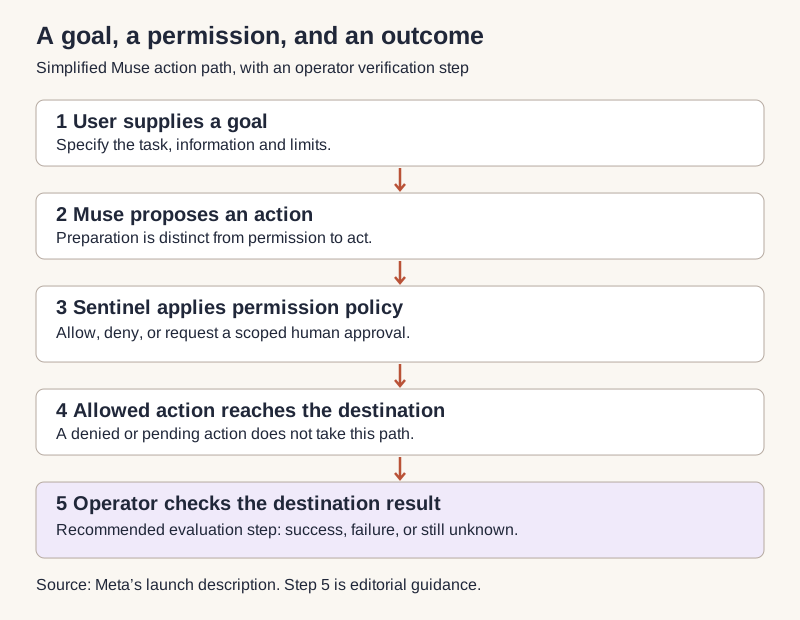
The separation creates a review point, but reviewers still need to see the proposed change. A plausible plan can name the wrong recipient, account or time. The production-agent execution contract uses a bounded action against a defined state as the unit of approval, so the reviewer can judge a specific proposed change rather than endorse the agent’s general goal.
For a message, that means seeing what would be sent, to whom, from which account and within which limits. For a calendar change, it also means comparing the proposal with the current event. Permission to edit calendars answers what class of operation is allowed; it does not establish that the proposal incorporates the latest schedule.
In a hypothetical workplace trial, Muse prepares a test team’s maintenance-calendar update. A coordinator moves the window while the proposal awaits review. The old proposal can still look sensible on its own, yet write obsolete information back into the event. Put the current event beside the proposed change and test whether the workflow exposes that conflict. Reconfirming only the original maintenance goal would miss it.
Updating the maintenance event in a test account
After the read-only exercise, a disposable test account can support a narrowly defined write trial. Inspect both destination-granted permissions and Muse’s controls. A chat instruction limiting actions is part of the assignment, but does not demonstrate that the account itself lacks broader authority.
Return to the maintenance event and exercise approval, rejection and a changed target. Retain proposed values, approved scope, destination result and any unresolved state. Use synthetic events in an authorized test environment; a live on-call schedule or actual incident notification is an unnecessary consequence for demonstrating the feature.
A timeout is another case worth distinguishing. The unknown-write reconciliation guide explains how a missing response can follow an action that already happened. Inspect the calendar or other destination before retrying, or a second attempt may create a duplicate. If the result cannot be established, stop dependent work and assign that uncertainty to a human owner.
Ending access likewise addresses future authority, not every earlier effect. It cannot unsend a message or prove an accepted request was cancelled. At the trial’s end, inspect outstanding work and partial destination changes, then remove trial access through supported controls. That checks the actual stopping behavior without promising that all work can be rolled back.
The launch privacy controls and planned Confidential VM
Meta’s September 8 account says the launch design does not technically prevent Meta from accessing VM data when needed to operate the service. It describes model-training opt-out controls and Confidential VM as a later capability. Treating that future capability as an existing account protection would change the data decision without evidence.
The organization still needs current answers on permitted data, retention, deletion, administration, audit export and support. Training opt-out may address one requirement, but does not settle the others or create contractual arrangements. A public-source digest remains useful while those questions are being resolved because its output can be evaluated without prematurely broadening the information supplied.
The digest makes Muse’s persistence tangible: the assistant can revisit the same release-note sources and leave an update for a reviewer. The maintenance event adds a different problem, keeping a proposed change aligned with a schedule that may have moved. If the workflow cannot establish that current state or the result of a write, a draft-only role can still provide useful preparation while the coordinator makes the change.
Sources & context
Sources linked in this article. Read alongside the author’s analysis; a citation does not independently verify a publisher’s claims.
- introduced the Muse personal agent on September 8, 2026about.fb.com
- product-design accountintroducing.muse.ai
- September 23 research postresearch.meta.ai
- launch architecture descriptionresearch.meta.ai