GuideAI in production
Hermes Agent guide: what it is, when to use it, and how to get started
Understand Hermes Agent, its origins, models, memory and skills. Choose a setup, try two checkable examples, and learn where its limits matter.
Guides, news and explanations about AI and reliable systems.
Understand Hermes Agent, its origins, models, memory and skills. Choose a setup, try two checkable examples, and learn where its limits matter.
Connect logical tasks to every model and tool attempt, then measure cost and latency per accepted outcome without hiding failed or unknown work.
Run a candidate log classifier beside the current route, preserve complete outcomes, and promote only the slices whose mistakes and review cost are understood.
A client-side SSE probe separates first answer text from normal completion. Fixed arrivals and outcome counts show whether a serving change delivers more useful answers.
Follow a slow AI request from Cloudflare to an instrumented origin, configure sampling, and verify that the trace preserves the evidence needed to investigate.
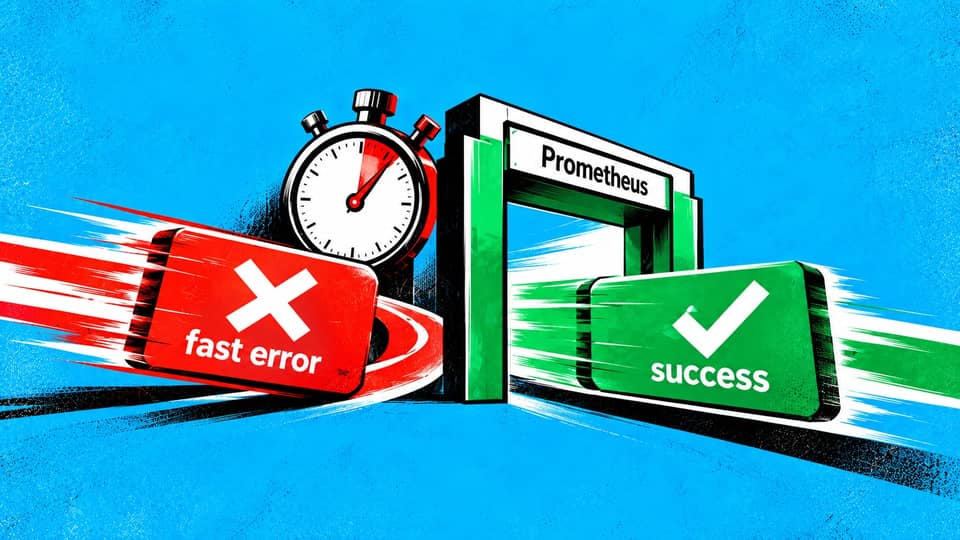
Build a latency SLI from Prometheus histogram buckets, include failed requests, and compare classic and native queries with a worked search-service example.
Tail sampling selects recorded traces by error, latency and other evidence. A checkout timeout shows how routing, waiting time and memory affect the trace a responder can retrieve.
A durable queue can preserve telemetry through an outage, then take longer to catch up. Arrival rate, export capacity and event age explain what recovery looks like.
Zero errors, no traffic and absent series produce different PromQL results. Synthetic tests show how ratios, fallback zeros and absence checks behave for a checkout service.
Use instrumentation and context propagation to connect the evidence in an investigation.
Grouping can shorten the incident queue while hiding a second failure. Following a replay past the first mitigation reveals whether that failure stays visible.
Regional failures can disappear in fleet averages. Grafana queries, population labels and linked traces help responders find the affected requests.